

Article by
Graham Beck
Graham Beck is the Co-founder and CEO of DropDesk, a platform dedicated to a singular, transformative mission: unlocking the potential of underutilized spaces to foster human connection.
Graham Beck is the Co-founder and CEO of DropDesk, a platform dedicated to a singular, transformative mission: unlocking the potential of underutilized spaces to foster human connection.
Whether you need a space, want to earn from yours, or are ready to build your own marketplace — we have you covered.
Discover unique local venues for work, meetings, events, and celebrations.
Explore Spaces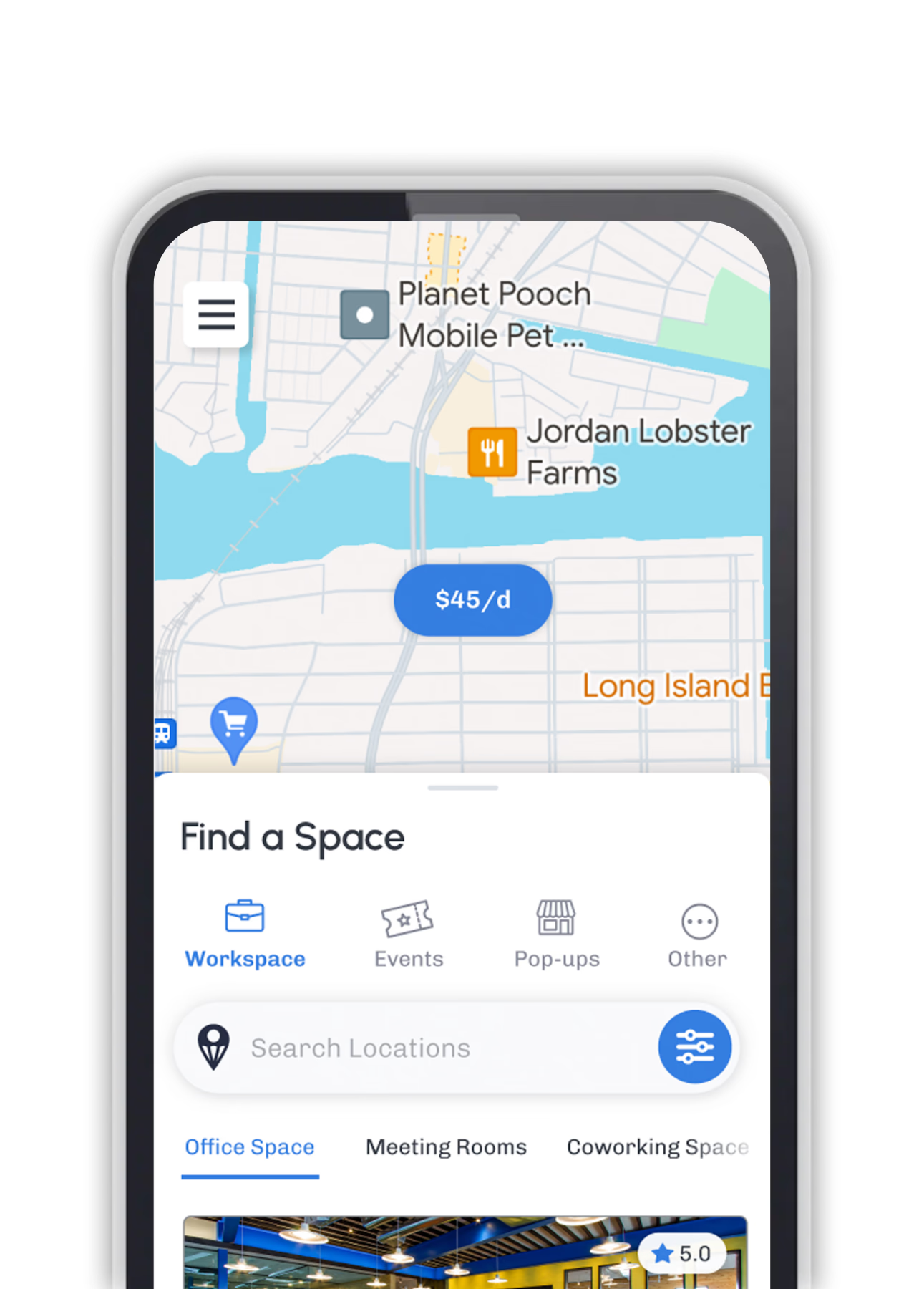
Book your favorite spots on the go. Available on iOS and Android.
Key takeaways
Choosing marketplace software is one of those decisions that feels small until you're six months in and realize the platform you picked can't do the one thing your business actually depends on. The "best" marketplace software isn't a single product — it's the one that fits your marketplace type, your budget, and how fast you need to launch.
This guide skips the bloated 50-tool listicle. Instead, it gives you a simple framework for choosing, an honest comparison of the platforms founders actually use in 2026, and clear recommendations by marketplace type — including where each tool wins and where it falls short.
Before comparing products, make sure software is the right path at all. There are three ways to build a marketplace:
For roughly 90% of founders, marketplace software is the right starting point. Trying to build a secure, compliant production platform from scratch right away is a massive financial and structural risk:
Skip software only if (a) you can validate the idea entirely by hand first, or (b) your proprietary technology is your sole competitive advantage. Otherwise, start with a platform.
To help visualize how quickly hidden fees accumulate depending on the path you choose, use the calculator below to compare flat native software costs against traditional plugin-heavy ecosystems and custom developments.
Adjust the inputs to compare a flat native platform against a plugin-heavy ecosystem and a fully custom build.
Native all-in-one SaaS
Hosting & plugins included
$2,388
Plugin-heavy / self-hosted
Base + per-plugin fees + server hosting
$3,828
Fully custom build
Engineering + infrastructure + DevOps
$207,200
Estimates are illustrative defaults for comparison only. Native pricing assumes hosting and core features are bundled; plugin and custom paths add server, extension, and maintenance costs on top of the base license.
Most comparison guides drown you in feature checklists. In practice, the choice comes down to five questions:
| Criterion | Why it matters | What to ask |
|---|---|---|
| Marketplace type | A rental platform, a B2B service marketplace, and a C2C product marketplace have fundamentally different needs. | Does this tool natively support my specific interaction model? |
| Pricing model & TCO | Some platforms charge a flat subscription; others take a cut of revenue. Crucially, many rely on paid third-party plugins for basic features. | Is this platform all-inclusive, or will I face a heavy "plugin tax" to get core features working? |
| Time to market | No-code launches in hours; custom-extensible platforms take longer but may scale further down the line. | How fast can I get a working version in front of real users? |
| Extensibility | The moment you need something custom, a closed platform becomes a ceiling. | Can I customize the code or add proprietary features later? |
| Payments & payouts | Splitting payments between you and your sellers is the hardest part to build yourself. | Does it handle multi-party payouts (like Stripe Connect) safely out of the box? |
If you only optimize for one thing, make it marketplace type. Everything else is recoverable; building on a platform that can't naturally model your base transactions is not.
When founders budget for a marketplace, they often look exclusively at the software license and forget that an active app has to live somewhere. Because marketplaces handle heavy image uploads from sellers, continuous search queries, and real-time transaction webhooks, their infrastructure needs are much higher than a standard blog or marketing site.
Depending on the architecture you choose, hosting and maintenance fall into three clear buckets:
Here are the platforms founders most commonly trust, what they're best at, and their architectural trade-offs. There's no single winner — the right pick depends on your model.
| Platform | Best for | Pricing model | No-code? | Watch-out / Architecture |
|---|---|---|---|---|
| DropDesk | Booking, space, and subscription marketplaces (workspaces, venues, rentals by time) | Flat service fee and/or negotiated revenue share* | Yes | All-in-one native infrastructure (zero third-party plugin fees & hosting included). Built for booking models, not product retail. |
| Sharetribe | C2C and service marketplaces, unique/complex concepts | Flat fee + transaction fee + dev fees*** | Yes | Advanced customization or niche workflows often require developer help or third-party integrations. |
| CS-Cart | B2C/B2B ecommerce (product) marketplaces | License/subscription | Partial | Heavier enterprise setup; requires external hosting and frequently relies on purchasing extensions from their plugin ecosystem. |
| Arcadier | Broad multi-type marketplaces, some enterprise | Subscription + fees | Yes | Base is simple, but additional module/plugin costs stack up quickly as you scale. |
| Marketplacer | Enterprise retailers and brands adding a marketplace | Custom/enterprise | No | Enterprise pricing and heavy structural onboarding. |
| Mirakl | Large enterprise B2B/B2C operators | Custom/enterprise | No | Complete overkill (and over-budget) for early-stage and mid-market founders. |
| Bubble | Founders who want to build the whole thing visually themselves | Subscription | Yes (DIY) | You are building from primitives — maximum layout control, but heavily reliant on paid third-party plugins for complex tasks. |
*DropDesk pricing is a flat service fee and/or a negotiated revenue share, depending on your model and volume. ***Sharetribe combines a flat subscription fee, a per-transaction fee, and developer fees for custom work.
Weighing the two most popular no-code options? Compare DropDesk vs. Sharetribe side by side to see which fits your marketplace model. Or compare all marketplace platforms in one place.
A note on honesty: we make DropDesk, and we've listed it where it genuinely fits — booking, space, and subscription marketplaces. If you're building a C2C product marketplace or an enterprise retail marketplace, one of the others above is a better call, and we'll happily tell you so. A platform that doesn't fit your core layout is never the "best," regardless of who makes it.
DropDesk. If your marketplace sells time and access — coworking desks, meeting rooms, event venues, studios, or equipment rentals — you need availability calendars, time-slot booking, and recurring billing baked directly into the core code. General product platforms bolt these on awkwardly using messy, expensive third-party plugins.
DropDesk uses a 100% native architecture, meaning features like complex scheduling, multi-party payouts, and subscription billing work out of the box with zero hidden "plugin taxes" or third-party tool fees. Hosting and scaling infrastructure are completely managed inline, so you don't have to manage external cloud servers. The only trade-off? It is laser-focused on booking and access models, so it isn't the right fit for traditional physical product retail. (See the Marketplace Builder.)
Sharetribe. A decade of powering peer-to-peer and service marketplaces, with strong flexibility for unusual concepts. Great default for standard ecommerce, product trading, and classic C2C — though deep code customization will eventually involve an experienced developer.
CS-Cart. Purpose-built for multi-vendor product retail with a robust catalog and deep vendor management dashboards. The trade-off is a significantly heavier, older installation process than modern no-code software, alongside separate infrastructure and hosting maintenance.
Marketplacer or Mirakl. If you're an established international brand or retailer layering an endless-aisle marketplace onto an existing commercial business, these enterprise platforms are designed for that scale — with the multi-year pricing and onboarding to match.
Bubble. If you want to design every single screen and database relationship yourself and you have the spare months to learn visual development, a raw visual builder gives you total control at the cost of doing all the heavy algorithmic lifting.
Narrowing down your software choices is a process of elimination. If you follow these five strategic steps, your target stack becomes clear within a day.
Marketplace software is an all-in-one or modular platform that provides the core digital building blocks of a multi-vendor online marketplace — including dual-user listings, search logic, customer profiles, internal messaging, and multi-party split payments — so you can launch without building the infrastructure yourself.
Most modern SaaS marketplace platforms cost $12,000–$20,000 per year for their base tiers. Enterprise systems require custom contracts that scale much higher. By comparison, hiring professional engineers to construct a fully custom, secure, production-ready platform from scratch typically starts at $300,000+.
Often, yes. Many legacy platforms operate on an ecosystem model. While their base subscription fee appears low, you frequently have to pay mandatory extra monthly fees for essential third-party plugins, extensions, or external APIs just to make things like advanced scheduling or local tax collection functional. Look for tools built with native, all-in-one architectures if you want an entirely stable monthly budget.
With SaaS platforms, hosting, CDNs, and database maintenance are entirely covered under your subscription. With self-hosted platforms (like on-premises installations), you buy a license to the software but must pay an external cloud provider (like AWS or DigitalOcean) $50 to $300+/month to keep the platform live, while taking on the personal technical responsibility for server crashes and regular code backups.
A take rate (or transaction commission) charges a percentage of every purchase made on your platform; a subscription charges a flat recurring fee regardless of your transaction volume. Subscriptions offer highly predictable expenses; take rates scale automatically with your revenue but can eat into narrow marketplace margins over time.
Yes. No-code solutions like DropDesk, Sharetribe, and Arcadier enable you to build a live marketplace — complete with vendor portals, billing pipelines, and matching logic — without typing a single line of code. Custom manual code is only necessary when your concept requires deeply proprietary algorithms or non-standard hardware integrations.
The fastest path is an all-inclusive no-code platform that natively maps to your transaction type (e.g., booking software for space rentals, or multi-vendor catalogs for retail items). Validate organic market demand first, then reinvest in deeper customization once your sellers are regularly transacting.
Most platforms natively integrate a specialized payment orchestration layer (like Stripe Connect) to split incoming buyer payments between your platform take-rate and your specific seller's bank account, automatically running global KYC (Know Your Customer) compliance checkouts. If you're analyzing payment pathways specifically, read our comprehensive guide to Stripe fees for marketplace operators.
There's no universal "best" marketplace software — only the best architectural fit for your model, budget, and timeline. Name your marketplace type, audit the software for hidden plugin and server hosting costs, choose your pricing model tolerance, and confirm payment split logic works out of the box. Do that and the shortlist picks itself.
If you're building a booking, space, or subscription marketplace, DropDesk's Marketplace Builder lets you launch a fully functional, no-code platform — with scheduling, listings, hosting, and recurring billing entirely native. If you're building something else, use the framework above to find the platform that matches.
Want to go deeper on the business side? Read What is an online marketplace? and How does a marketplace work?
