

Article by
Graham Beck
Graham Beck is the Co-founder and CEO of DropDesk, a platform dedicated to a singular, transformative mission: unlocking the potential of underutilized spaces to foster human connection.
Graham Beck is the Co-founder and CEO of DropDesk, a platform dedicated to a singular, transformative mission: unlocking the potential of underutilized spaces to foster human connection.
Whether you need a space, want to earn from yours, or are ready to build your own marketplace — we have you covered.
Discover unique local venues for work, meetings, events, and celebrations.
Explore Spaces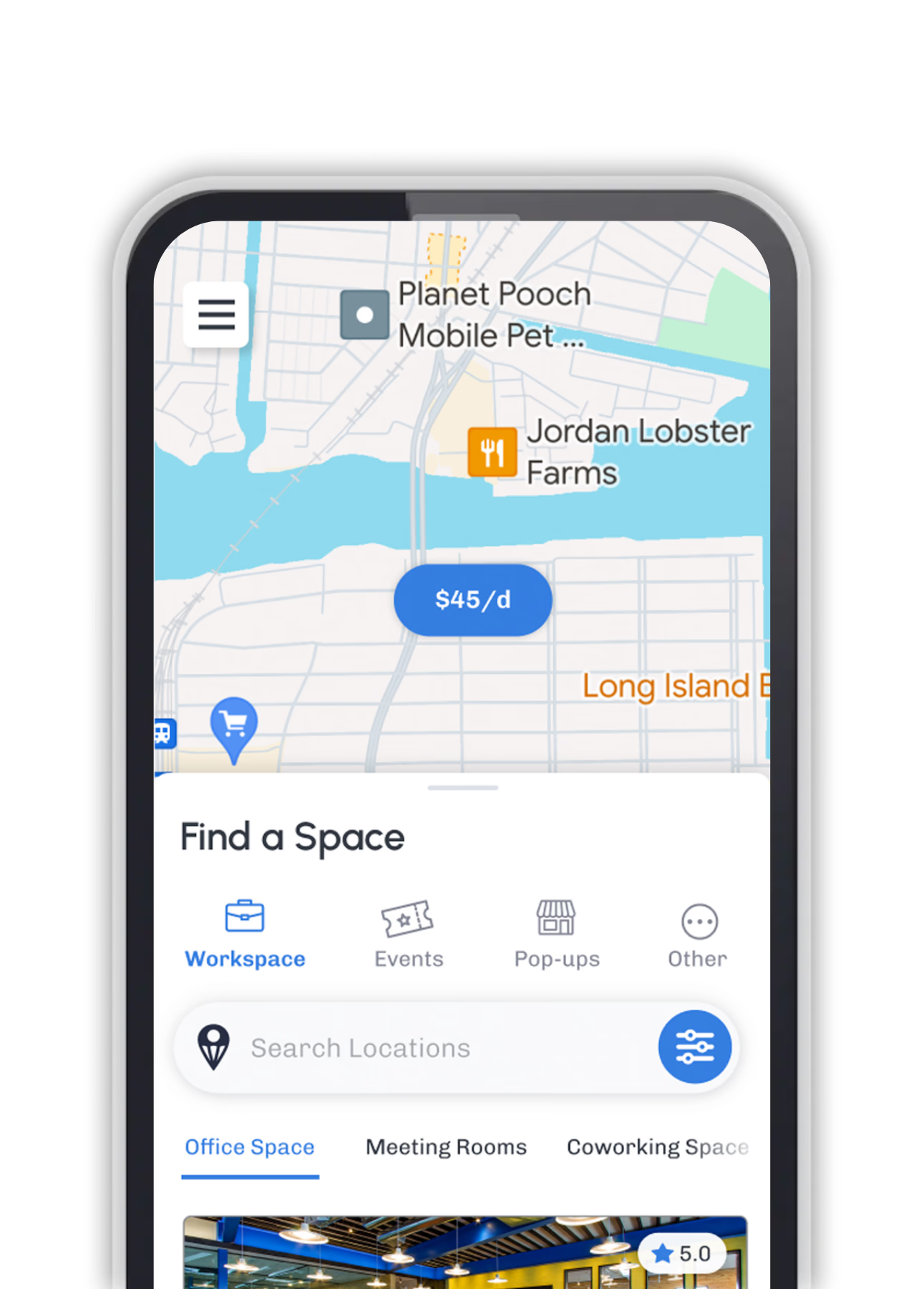
Book your favorite spots on the go. Available on iOS and Android.
Key takeaways
An online marketplace is one of the most familiar things on the internet, yet one of the most quietly complicated businesses to operate. From the outside, it just looks like a website. You search for something, click, pay, and it shows up. Easy.
Underneath that simple surface is a tightly engineered machine: matching algorithms, two-sided onboarding, escrow payments, identity checks, dispute systems, review flywheels, and a revenue model that has to work for the buyer, the seller, and the platform at the same time.
This guide walks through what an online marketplace actually is, how it works under the hood, the four main types, the seven business models that power them, the most useful examples in each category, and the proven playbook for building one in 2026.
An online marketplace is a website or app where multiple sellers offer products or services to buyers in one shared digital environment. Unlike a traditional online store that sells its own inventory, a marketplace does not own the products it lists. Instead, it connects independent sellers with buyers, processes the transaction, and earns a fee for facilitating the deal.
Think of it like a digital shopping mall. The mall owner doesn't sell products — they provide the space, handle security, and set the rules. Sellers rent space and bring their own products, while shoppers enjoy browsing many stores under one roof.
The canonical examples are Amazon's third-party marketplace, Airbnb, eBay, Etsy, Uber, Booking.com, and Fiverr. Each one matches a different supply (products, homes, rides, freelancers, hotels) with the same demand: people who want a wide selection in one place.
Here's a simple visual of how the model works:

Three things distinguish a marketplace from a regular online store:
Every marketplace, in every category, runs essentially the same loop. Different platforms emphasise different steps, but if you understand these eight stages you understand how almost any online marketplace works.
A seller — a homeowner, a freelancer, a brand, a craftsperson, a venue operator — signs up and creates a listing with photos, description, price, availability, and any category-specific data. Modern marketplaces invest heavily in templates, prompts, and AI-assisted listing tools because the average seller is not a professional copywriter, and bad listings kill conversion.
Behind the scenes, the marketplace runs identity checks, fraud scoring, and quality gates on new listings. It then ranks each listing in search results based on relevance, freshness, conversion history, completion rate, and (often) ad spend. This ranking layer is the marketplace's most strategic piece of code — it determines who succeeds on the platform and who doesn't.
Buyers arrive via SEO, ads, social, app stores, referrals, or email and search, browse, filter, and compare. Discovery is the single hardest UX problem a marketplace has, because supply is fragmented and intent is fuzzy.
Strangers transact with strangers, which only works if the platform reduces uncertainty. The trust layer includes two-sided reviews, verified profiles, ID checks, badges, photo standards, buyer protection, and insurance for high-value categories (Airbnb's host guarantee, Turo's vehicle coverage). The trust layer is the marketplace's compounding asset.
The buyer pays the platform, not the seller. This single design choice is non-negotiable for any serious marketplace because it lets the platform take its cut, hold funds in escrow, issue refunds, detect fraud, and stop users from going off-platform. Stripe Connect, Adyen for Platforms, and PayPal Marketplaces are the standard rails.
The actual exchange of value happens between the two users. The host hosts. The driver drives. The seller ships. The freelancer delivers. The platform may help — shipping labels, route optimisation, in-app messaging — but it doesn't do the thing being paid for.
Once the buyer confirms receipt (or a hold period elapses), the platform releases funds to the seller, minus its fee. Both sides leave a review. Disputes are handled by trust-and-safety teams. This is where many marketplaces quietly spend a third of their operational budget.
Every closed transaction adds reviews and behavioural data that improve the next match. New entrants have to start this flywheel from zero, which is why marketplaces with five years of reviews are surprisingly hard to dislodge — even by competitors with better technology.
The difference between a marketplace and a traditional online store isn't just terminology — it's a different business shape financially and operationally.
| Feature | Traditional Online Store (Pipeline) | Online Marketplace (Platform) |
|---|---|---|
| Inventory | High risk: the store buys and stores all stock | Asset-light: sellers own the products |
| Sellers | One (the store owner) | Many independent sellers |
| Growth | Linear: more warehouses, more stock | Exponential: driven by network effects |
| Catalog | Limited by budget and storage | Virtually unlimited |
| Margin | Higher per-unit, lower scalability | Lower per-unit, higher scalability |
| Risk | Sits with the store | Distributed across sellers |

The trade-off is clear: a traditional store has tighter operational control and unit economics, while a marketplace trades that for scalability and network effects. Once a marketplace reaches a critical mass of sellers and buyers, it becomes very hard to displace.
Marketplaces are typically categorised by who is selling and who is buying, and separately by how broad or narrow their focus is.
C2C marketplaces — sometimes called peer-to-peer marketplaces — connect everyday people who want to buy, sell, or rent directly from each other.
B2C marketplaces connect professional businesses — brands, retailers, wholesalers — with individual consumers. This is the most common model in retail.
B2B marketplaces facilitate transactions between companies.
Less common, but a real category. Individuals offer products or services that businesses buy.
Cutting across the four types above is a second dimension — how broad or narrow the catalogue is.
A useful pattern from the last decade: vertical marketplaces are eating horizontal ones in B2B and high-trust categories. Buyers in specialised verticals want depth, not breadth, and a vertical platform's ranking, search, and trust signals are tuned for the category.
The marketplace model creates value for all three sides by decoupling asset ownership from value creation.
Most explainers list "marketplace types" — B2C, B2B, P2P — and stop there. Those are audience segments, not business models. The business model is how the platform generates revenue from the loop above. Here are the seven you'll see in the wild.
The platform takes a percentage or flat fee from every successful transaction. The default model.
Buyers, sellers, or both pay a recurring fee for access. Per-transaction fees are zero, low, or capped.
Sellers pay a flat fee to post an item, regardless of whether it sells.
The platform charges sellers when it delivers a qualified lead — a phone call, a quote request, a contact unlock — regardless of whether the lead converts.
Core marketplace is free; premium features, tools, or visibility cost extra.
The platform sells visibility — sponsored listings, top-of-search slots, banner ads — to sellers or third-party advertisers.
Most successful marketplaces aren't just one of the above — they layer multiple models.
If you're modelling a new marketplace, plan for hybrid eventually even if you launch with a single model. The mature equilibrium for almost every successful marketplace is a stack of two or three models.
At launch, you need sellers to attract buyers — but sellers won't join without buyers.
Solution: focus on supply first. It's easier to acquire sellers (who want to make money) than buyers (who have to spend money). Subsidise, hand-recruit, or build a tool that's useful to sellers even before there's demand. Once supply exists, demand acquisition has something concrete to convert against.

Users may use the platform to meet, then transact offline to avoid your fees.
Solution: provide value beyond the connection. Bundle escrow payments, insurance, dispute resolution, scheduling, and analytics tools that disappear if users go off-platform. The fee should feel like a discount on what they'd pay separately, not a tax.
Liquidity is the probability that a buyer finds what they want and a seller finds a buyer in a reasonable time. Without liquidity, a marketplace feels empty no matter how much traffic it has.
Solution: track "search-to-fill" rates. If users repeatedly search for "conference rooms" and get zero results, you have a precise signal on the next supply to acquire. Liquidity, not traffic, is the metric to optimise.
The era of multi-year, million-dollar marketplace builds is over. To succeed today, you need to validate, build, and launch quickly.
Before writing a single line of code, confirm demand. Manually connect buyers and sellers via email or spreadsheets. If you can't make a transaction happen by hand, software won't fix the underlying lack of demand.
Three main options, ordered by time-to-market:

Don't try to be everything to everyone. Win one niche completely before moving to the next.
Offer a tool that's valuable to the seller even without buyers. This seeds your supply organically because the software earns its keep on day one — well before there's enough demand to need a marketplace at all. Venue management software, freelancer invoicing, host calendar tools, and inventory dashboards all serve this role.
If you're trying to model a new marketplace or just calibrate what's possible, here's a category-spanning reference list of well-known online marketplaces.
A useful pattern in the list above: every successful marketplace started in a single niche and stayed there long enough to build trust before expanding. Airbnb was air mattresses in San Francisco. Etsy was crafts. eBay was Pez dispensers and Beanie Babies. Founders who try to be a "marketplace for everything" on day one almost universally fail.
An online marketplace is a website or app that brings together multiple sellers and buyers in one place. The marketplace itself doesn't sell products — it provides the platform where others can transact, and earns money from facilitating the deal.
A horizontal marketplace is a "one-stop shop" that sells across many unrelated categories (Amazon, eBay). A vertical marketplace specialises in a single industry or niche (StockX for sneakers, DropDesk for workspaces) to offer deeper expertise and tailored features.
It depends on your network. B2C marketplaces require high marketing spend to reach mass consumers. B2B marketplaces rely on higher-value orders and direct relationships, often requiring sales effort but less mass advertising. Founders with industry contacts usually win faster in B2B.
Yes. No-code marketplace platforms like DropDesk let you launch a functional marketplace in days without writing code. This is especially useful for validating your idea before investing in custom development.
The "chicken-and-egg" problem: attracting sellers when there are no buyers, and attracting buyers when there are no sellers. Most successful marketplaces solve it by focusing on supply first and starting in a narrow niche.
Both, technically. Amazon sells its own inventory (first-party retail) and operates a third-party marketplace where independent sellers list goods. Over half of all units sold on Amazon now come from third-party sellers, making it the canonical hybrid marketplace.
Commission rates typically sit between 5% and 20%, depending on category. Services and digital goods often see 15%–30%. Travel and high-volume rentals tend to be lower (3%–15%). Subscription marketplaces often replace per-transaction fees with a recurring $20–$300/month seller subscription instead.
The online marketplace model is the closest thing in commerce to a perpetual-motion machine: an asset-light platform that grows through network effects, compounds via reputation, and scales globally without owning a single product. The opportunity for scale is unmatched, whether you're facilitating global B2B procurement or hyper-local space rentals.
But success requires more than a good idea. It requires solving the chicken-and-egg problem, picking the right business model for your category, and using the right tools to launch fast — because the longer it takes to reach liquidity, the lower the odds you ever get there.
If you're building a rental, booking, or services marketplace, DropDesk's no-code Marketplace Builder handles the hardest parts — calendars, payments, trust, and host onboarding — out of the box. Launch in days, not months. See essential marketplace pages →
Article by Graham Beck — Co-founder and CEO of DropDesk, a platform dedicated to unlocking the potential of underutilised spaces to foster human connection.
