

Article by
Graham Beck
Graham Beck is the Co-founder and CEO of DropDesk, a platform dedicated to a singular, transformative mission: unlocking the potential of underutilized spaces to foster human connection.
Graham Beck is the Co-founder and CEO of DropDesk, a platform dedicated to a singular, transformative mission: unlocking the potential of underutilized spaces to foster human connection.
Whether you need a space, want to earn from yours, or are ready to build your own marketplace — we have you covered.
Discover unique local venues for work, meetings, events, and celebrations.
Explore Spaces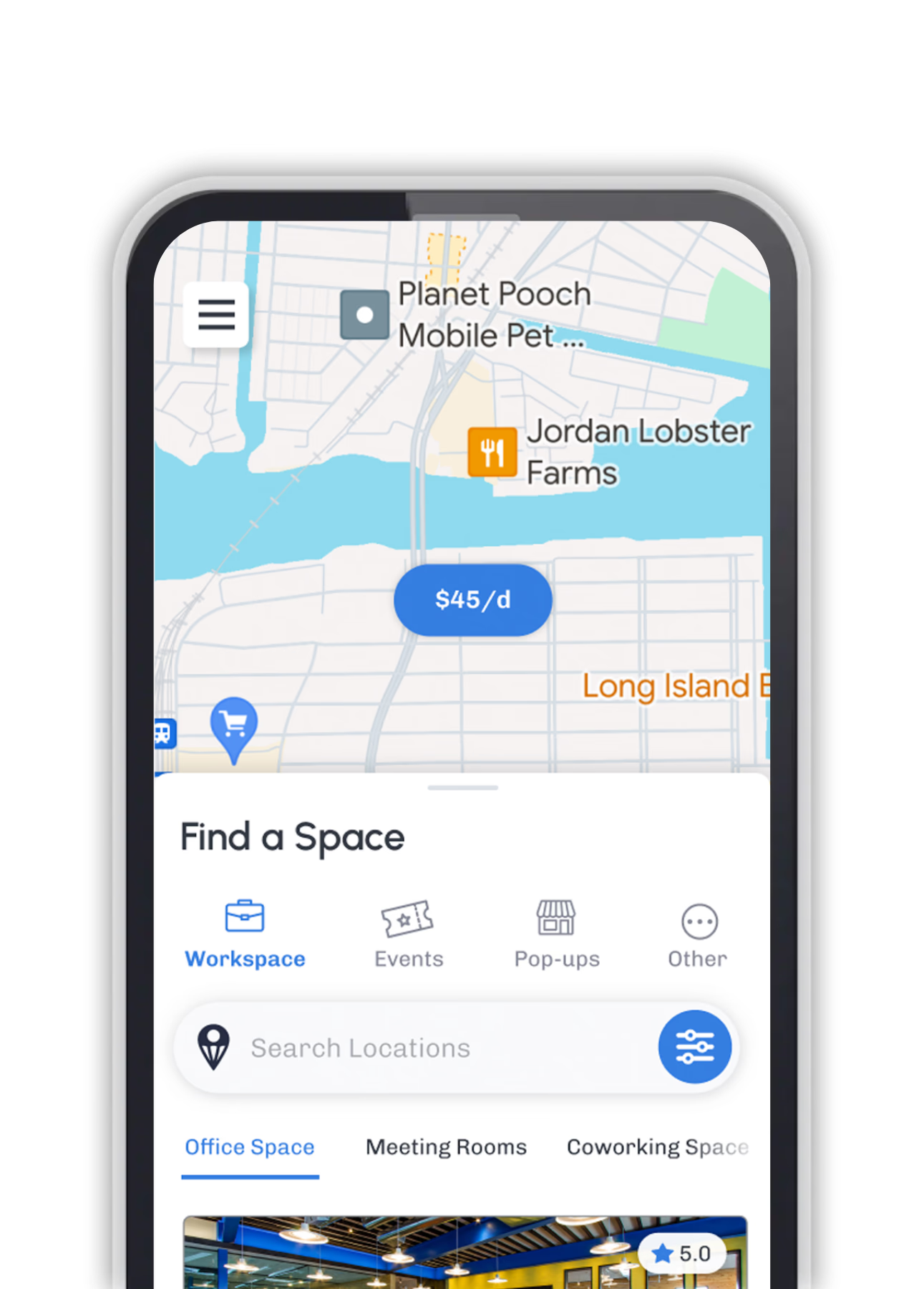
Book your favorite spots on the go. Available on iOS and Android.
Key takeaways
Quick answer: A hybrid marketplace is an online marketplace that blends two or more business models in one platform — most commonly mixing a peer-to-peer (P2P) model, where independent third parties list and sell, with a first-party (1P) model, where the platform sells its own inventory or services directly. The result is a single storefront that offers both the breadth of an open marketplace and the control of a managed retailer. Amazon is the most famous example: it sells products itself and lets millions of third-party sellers list alongside it.
That's the one-sentence version. But "hybrid" covers a lot of ground, and choosing the right blend is one of the highest-leverage decisions a marketplace founder makes. This guide explains what a hybrid marketplace actually is, the main types, why operators choose the model, the trade-offs, and how to tell whether it's right for what you're building.
Before you can understand a hybrid marketplace, it helps to be clear on the pure models it's blending. Almost every marketplace is built from some combination of these three.
| Model | Who owns/controls supply | Platform's role | Classic example |
|---|---|---|---|
| First-party (1P) / Retailer | The platform owns the inventory | Buys, stocks, prices, and sells directly | A traditional online store |
| Third-party (3P) / Peer-to-peer (P2P) | Independent sellers own supply | Connects buyers and sellers; takes a fee | eBay, Airbnb, Etsy |
| Managed marketplace | Independent sellers own supply, but the platform manages the experience | Curates, sets quality standards, handles payments/logistics/trust | StockX, Grailed, many service marketplaces |
A hybrid marketplace combines two or more of these into one platform. The most common form is 1P + 3P — the platform sells some things itself and lets others sell the rest. But "hybrid" is broader than that single recipe, which is where it gets interesting. (For the fundamentals, see How does a marketplace work?)
A hybrid marketplace is any marketplace that deliberately runs more than one supply or monetization model at the same time, in the same experience. The "hybrid" can show up in a few different dimensions:
The unifying idea: instead of forcing your business into one rigid model, a hybrid marketplace lets you match the right model to the right segment of your supply and demand.
The textbook hybrid. The platform stocks and sells popular or strategic items itself (controlling margin, quality, and availability) while opening the long tail to third-party sellers (gaining selection without holding inventory).
Here the "hybrid" is about how much the platform does for the seller. High-value or high-risk listings get the managed treatment — authentication, photography, pricing guidance, fulfillment — while the rest are self-serve.
The platform sells physical products and services (or experiences) under one roof, because that's how the customer actually thinks about the job to be done.
The platform earns a take rate on each transaction and layers in recurring revenue — memberships, SaaS-style seller tools, or subscription access for buyers.
The platform serves both businesses and consumers from the same supply base, adapting pricing, terms, and minimums to each audience.
Founders rarely set out to "build a hybrid" for its own sake. They arrive at it because a pure model leaves something on the table. The common drivers:
A hybrid marketplace is powerful, but it is not free. The cost is complexity, and it shows up in predictable places:
A useful rule of thumb: start with the single model that best fits your core transaction, prove it works, then add the second model to capture value you're visibly leaving behind. Hybrids are best grown into, not launched cold.
| Pure P2P / 3P | Managed marketplace | Hybrid marketplace | |
|---|---|---|---|
| Platform owns inventory? | No | No (but manages it) | Sometimes (the 1P part) |
| Control over experience | Low | High | Selectively high |
| Operational complexity | Low | High | Highest |
| Speed to liquidity | Slow (cold-start) | Medium | Faster (can seed supply) |
| Revenue mechanics | Usually one (take rate) | Usually one (take rate, sometimes higher) | Multiple (take rate + 1P margin + subscription + ads) |
| Best when | Supply is abundant and trust is easy | Trust/quality is the core problem | You need both breadth and control |
Ask yourself these five questions:
If you answered "yes" to two or more — especially #1 and #2 — a hybrid model is worth designing toward.
You don't have to launch every model on day one (and you shouldn't). The pragmatic sequence:
A note from us: we make DropDesk, a platform for booking, space, and subscription marketplaces — exactly the kind of business that tends to go hybrid (renting access and selling memberships, often with operator-set take rates). If you're building a hybrid in that world, it's worth a look. If you're building a C2C product marketplace or an enterprise retail hybrid, other platforms will fit better, and we'll say so — a tool that doesn't match your model is never the right one.
A hybrid marketplace is an online platform that runs more than one business model at once — for example, selling some products or services itself while also letting independent third parties sell, or earning through both a per-transaction fee and a subscription. It blends the breadth of an open marketplace with the control of a managed or first-party seller.
Amazon is the classic example: it sells its own inventory (first-party) and hosts millions of third-party sellers on the same site. Other examples include Walmart Marketplace, StockX (managed authentication plus open listings), and booking platforms that rent by the hour and sell monthly memberships.
A managed marketplace runs one model — third-party supply that the platform curates and operates (authentication, payments, logistics). A hybrid marketplace runs two or more models at once, which often includes a managed lane alongside, say, first-party inventory or self-serve listings.
A pure P2P marketplace only connects independent buyers and sellers and takes a fee. A hybrid adds at least one more model — first-party inventory, a managed/curated lane, subscriptions, or ads — so it isn't relying on third-party supply and a single take rate alone.
To reach liquidity faster (by seeding its own supply), to guarantee quality on key inventory while still scaling selection, to diversify revenue beyond a single take rate, and to capture more of the customer's needs (goods and services, B2B and B2C).
Mainly complexity: two sets of operations, potential channel conflict (competing with your own sellers), harder brand positioning, and significantly more demanding payments and tech — you have to handle your own revenue, seller payouts, and subscriptions simultaneously.
Start with the single model that fits your core transaction, reach liquidity on it, then add a second model where you're clearly leaving value on the table. Use a marketplace platform with built-in multi-party payments and configurable take rates so you don't have to build the hardest plumbing yourself.
If your marketplace is heading toward a hybrid model — renting access and selling memberships, with operator-set take rates — DropDesk's Marketplace Builder handles the multi-party payments, subscriptions, and configurable take rates out of the box, so you don't have to build the hardest plumbing yourself.
Keep going: How does a marketplace work? · How to scale a marketplace business
