

Article by
Graham Beck
Graham Beck is the Co-founder and CEO of DropDesk, a platform dedicated to a singular, transformative mission: unlocking the potential of underutilized spaces to foster human connection.
Graham Beck is the Co-founder and CEO of DropDesk, a platform dedicated to a singular, transformative mission: unlocking the potential of underutilized spaces to foster human connection.
Whether you need a space, want to earn from yours, or are ready to build your own marketplace — we have you covered.
Discover unique local venues for work, meetings, events, and celebrations.
Explore Spaces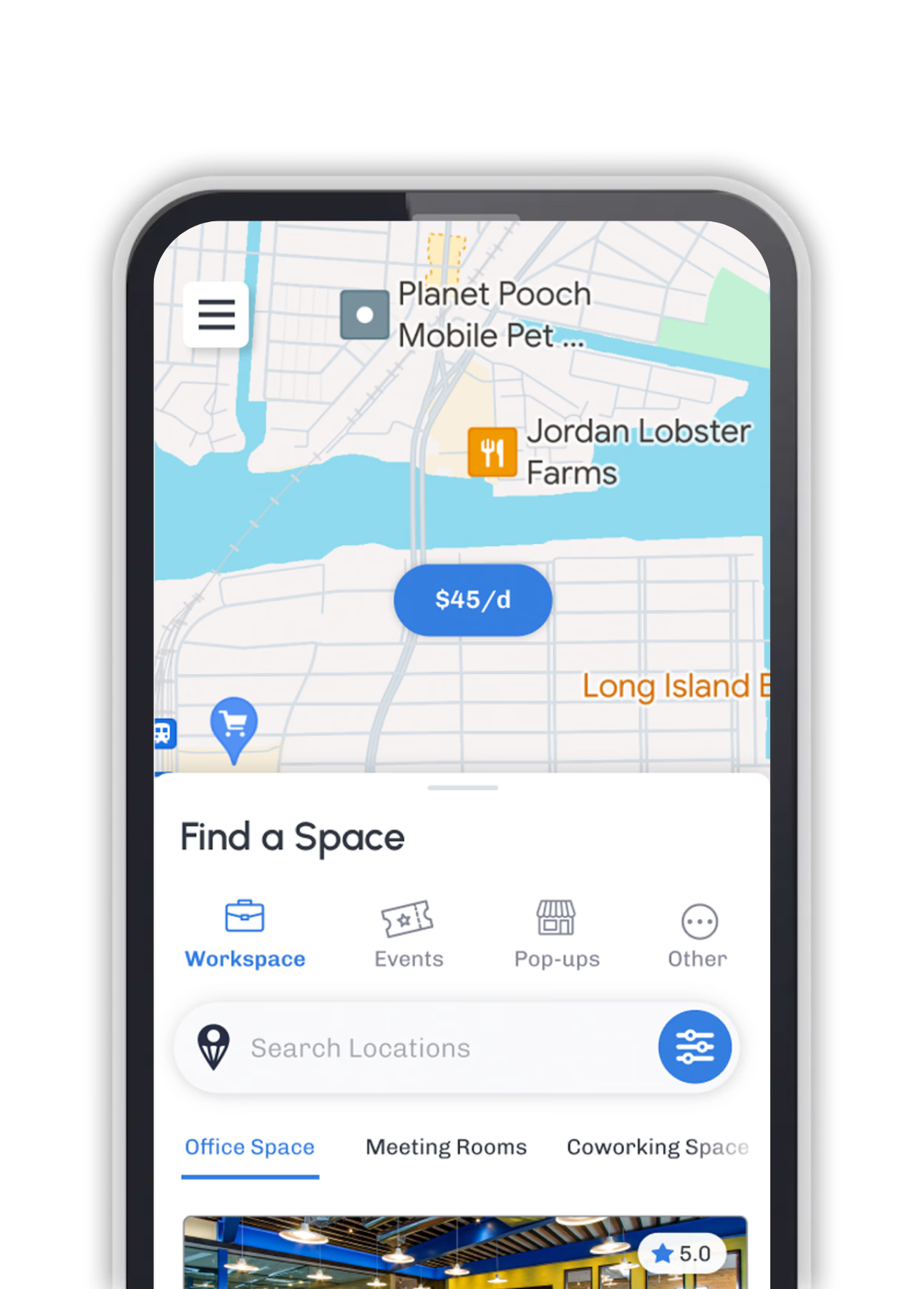
Book your favorite spots on the go. Available on iOS and Android.
What is coworking? Coworking is a flexible workspace arrangement where freelancers, remote workers, and teams from different companies share a professionally equipped office. Members pay monthly or by the day for access to desks, meeting rooms, WiFi, and amenities — without signing a long-term lease.
| Pros | Cons |
|---|---|
| No long-term lease | Less personalization than a private office |
| Built-in community and networking | Variable noise levels in open areas |
| Lower cost than a traditional office | Membership fees vs. free home office |
| Full amenities included | Quality varies dramatically between spaces |
| Better separation between work and home | Add-on fees can stack up |
| Access in dozens of cities under one membership | Not all spaces are 24/7 |
A coworking space is a shared, professionally equipped office where individuals and teams from different companies work side-by-side. It includes desks (hot desks, dedicated desks, or private offices), meeting rooms, high-speed WiFi, printers, coffee, and amenities — available through flexible memberships rather than multi-year leases.
Coworking emerged as a direct answer to three problems: the isolation of working from home, the rigidity of traditional leases, and the cost of building out office space for a small or distributed team. In 2026, there are more than 40,000 coworking spaces worldwide, serving an estimated 8+ million members.
Is it "coworking" or "co-working"? The Associated Press (AP) Stylebook officially recognized "coworking" (no hyphen) as the correct spelling in 2019. You'll still see "co-working" in older content, but "coworking" is the modern standard.
| Factor | Working from home | Coworking | Traditional office |
|---|---|---|---|
| Commitment | None | Month-to-month | 2-10 year lease |
| Upfront cost | $0 | First month + deposit | Security deposit + buildout ($50-$150/SF) |
| Amenities | DIY | Included | Build/manage yourself |
| Community | Isolated | Built-in | Internal only |
| Scalability | N/A | Add/remove seats monthly | Locked into SF |
| Professional appearance | Limited | Yes | Yes |
For an hour, a coffee shop or public library is fine. For a full workday with meetings, phone calls, reliable power, fast WiFi, and a professional environment, coworking is purpose-built. The right comparison is coworking vs. a fully built-out home office — not coworking vs. a free seat at a coffee shop.
| Factor | Cafe | Public library | Coworking |
|---|---|---|---|
| Cost | $5-$15 implied | Free | $20-$60/day pass |
| WiFi reliability | Variable | Often slow | Business-grade |
| Phone calls | Awkward | Not allowed | Phone booths available |
| Meeting rooms | No | Limited | Yes |
| Power outlets | Fight for them | Limited | Every seat |
| Hours | Limited | Limited | Often 24/7 |
The coworking member base has shifted dramatically. In 2015, freelancers and solopreneurs dominated. In 2026, corporate and hybrid teams are the fastest-growing segment.
Writers, designers, consultants, coaches, and independent professionals use coworking to escape the isolation of home offices, access meeting rooms for client calls, and network with potential collaborators. Hot desks and day passes are common entry points.
Full-time employees of distributed or remote-first companies often get coworking stipends. They use coworking as a regular alternative to home, optimizing for focus, separation, and social interaction.
Companies with HQ + distributed employees use coworking for regional hubs, offsites, and team weeks. Coworking lets them scale up or down without committing to long-term leases in every city.
Early-stage companies avoid the capital outlay and risk of a traditional lease. They start with a few dedicated desks or a small private office and add seats as they grow — or contract if the runway gets tight.
Large companies use coworking for regional offices, landing spots for traveling employees, and overflow space during peak hiring. Enterprise plans often include access across dozens of locations.
Location-independent workers use coworking for stable WiFi, ergonomic seating, and community while traveling. Day passes and global memberships (like the DropDesk network) are designed for this use case.
Coworking pricing varies widely by city, neighborhood, and membership tier. Major-city rates (NYC, SF, London) typically run 30-60% above national averages.
| Membership tier | National average (US) | Major city premium |
|---|---|---|
| Day pass | $20-$60 | $35-$75 |
| Hot desk (monthly) | $150-$300 | $300-$500 |
| Dedicated desk (monthly) | $300-$600 | $500-$900 |
| Private office (1-4 person) | $600-$2,500+ | $1,200-$4,000+ |
| Usually included | Often extra / capped |
|---|---|
| WiFi | Meeting room hours beyond credit |
| Coffee and tea | Printing (often metered) |
| Basic printing | Mail handling / virtual address |
| Lounge and common areas | Event space rental |
| Member directory access | Lockers / storage |
| Basic meeting room credits | Phone booths (some spaces) |
For most US freelancers, business owners, and self-employed professionals, coworking memberships are deductible as a business expense. W-2 employees generally cannot deduct memberships unless their employer reimburses. Outside the US, most jurisdictions treat memberships as deductible business expenses for the self-employed. Always consult a tax professional for your specific situation.
Myth: "Coworking is only for freelancers and startups."
Reality: Enterprise adoption is the fastest-growing segment. Companies like Microsoft, Salesforce, and Deloitte use coworking for satellite offices, hybrid teams, and overflow space.
Myth: "Coworking spaces are too loud to focus."
Reality: Most spaces have quiet zones, phone booths, and private offices. The "loud open floor" stereotype comes from early 2010s design; modern coworking is zoned for focus, collaboration, and calls.
Myth: "Coworking is more expensive than a home office."
Reality: A dedicated desk at $400/month may seem expensive — until you factor in the cost of a proper home office (furniture, WiFi upgrade, utilities, isolation), lost productivity, and no meeting room access.
Myth: "All coworking spaces are the same."
Reality: Quality varies wildly. Some spaces are beautifully designed, well-managed, and thriving. Others are half-empty, poorly maintained, and offer nothing beyond a desk. Always tour first.
Myth: "You need a long-term commitment."
Reality: Most coworking memberships are month-to-month. Many spaces offer day passes for drop-in work. Commitment levels range from zero (day pass) to 12 months (discounted annual plans).
Myth: "Coworking is just a fad."
Reality: JLL projects 30% of all office space will be consumed flexibly by 2030. Coworking has shifted from a niche option for freelancers to essential infrastructure for the hybrid economy.
| Brand | Focus | Typical price range | Best for |
|---|---|---|---|
| WeWork | Global scale, tech aesthetic | $$$ | Startups, enterprise overflow |
| Industrious | Hospitality-driven, enterprise | $$$ | Enterprise teams, premium seekers |
| Regus / Spaces | Global network, traditional | $$ | Traveling professionals, budget-conscious |
| Serendipity Labs | Premium suburban | $$$ | Suburb-based professionals |
| Local independents | Community, niche | $-$$ | Freelancers, community-focused |
| Drawback | Mitigation |
|---|---|
| Noise / distractions | Choose a space with quiet zones, phone booths, or private offices |
| Hidden fees | Ask for a full price sheet before signing — meeting rooms, printing, mail |
| Inconsistent quality | Tour before you commit; read recent reviews; take a day pass first |
| No guaranteed seat (hot desk) | Upgrade to a dedicated desk if you go in 3+ days/week |
| Commute required | Choose a space close to home, not downtown; suburban options are growing |
| Less control over environment | Select a private office if you need control; accept trade-offs for flexibility |
JLL projects that 30% of all office space will be consumed flexibly by 2030. Coworking has shifted from a niche option for freelancers to essential infrastructure for the hybrid economy. Enterprise adoption is accelerating; suburban and neighborhood spaces are multiplying; and technology is making booking, access, and community management seamless.
The question is no longer "Will coworking survive?" — it's "How will the best operators differentiate?" The winners will be those who combine great design, strong community, flexible terms, and transparent pricing.
Explore coworking spaces in these cities:
Coworking is a flexible workspace arrangement where freelancers, remote workers, and teams from different companies share a professionally equipped office. Members pay monthly or by the day for access to desks, meeting rooms, WiFi, and amenities — without signing a long-term lease.
A coworking space is a shared, professionally equipped office where individuals and teams from different organizations work side-by-side. It includes desks, meeting rooms, WiFi, printers, and amenities, available through flexible memberships rather than long-term leases.
Coworking memberships in the US typically cost $150-$300/month for a hot desk, $300-$600/month for a dedicated desk, and $600-$2,500+/month for a private office. Day passes range from $20-$60. Major-city rates run 30-60% above national averages.
For most US freelancers, business owners, and self-employed professionals, coworking memberships are deductible as a business expense. W-2 employees generally cannot deduct memberships unless their employer reimburses. Always consult a tax professional.
The main benefits are flexibility (no long-term lease), community and networking, a professional environment with full amenities, cost efficiency vs. a traditional lease, better work-life separation, and access to meeting rooms and event spaces.
Freelancers, remote employees, hybrid teams, startups, enterprise satellite teams, digital nomads, consultants, and agencies all use coworking. As of 2026, corporate adoption is the fastest-growing segment.
The five main types are general-purpose (open to all industries), niche or industry-specific, corporate coworking (private to one company), hybrid spaces (cafes, hotels with dedicated coworking areas), and suburban or neighborhood coworking.
Evaluate location, amenities, community vibe, contract flexibility, total pricing (including add-ons), hours of access, and member reviews. Always tour the space and take a day pass before committing to a monthly membership.
A hot desk is non-reserved — first-come, first-served seating. A dedicated desk is reserved exclusively for you, where you can leave equipment overnight. Hot desks are cheaper; dedicated desks are better if you go in 3+ days per week.
For an hour, a cafe or library is fine. For a full workday with meetings, phone calls, reliable power, fast WiFi, and a professional environment, coworking is purpose-built. The right comparison is coworking vs. a built-out home office, not coworking vs. a free seat at a coffee shop.
The Associated Press (AP) Stylebook officially recognized "coworking" (no hyphen) as the correct spelling in 2019. Both forms still appear in older content, but "coworking" is the modern standard.
Yes — JLL projects 30% of all office space will be consumed flexibly by 2030. Coworking has shifted from a niche option to essential infrastructure for the hybrid economy.
Yes — most coworking spaces offer day passes ranging from $20-$60. This is a great way to test a space before committing to a monthly membership.
Browse coworking spaces on DropDesk — filter by location, amenities, and price. Book a day pass or tour to get started.
Find a coworking space